Need it handled? Call (302) 832-2868
Auto Window Tinting: Window Tint Installation Services can help. Call (302) 832-2868 for a free estimate.
TL;DR
Your car's paint is chipping in New Castle because of a perfect storm: DelDOT's winter road salt and brine (October through March), highway gravel from I-95 traffic, freeze-thaw cycles that stress the paint, and factory clear coat that's only 1.5–2 mils thick. Learn more about clear bra paint protection in New Castle. The good news? You can stop it with paint protection film (PPF) before a $150 chip becomes a $1,500 panel repaint.
Why Is Car Paint Chipping So Common in New Castle?
If you're noticing paint chips on your car here in New Castle, you're not alone – and it's not your fault. Learn more about ceramic coating vs. paint protection film. Our roads and climate create a uniquely aggressive environment for automotive finishes.
Here's what's happening: Delaware's Department of Transportation applies liquid brine pre-treatment starting in October, followed by rock salt and sand during winter storms. (Noaa.gov) (Deldot.gov) That brine soaks into micro-cracks in your clear coat. Meanwhile, I-95 and Route 1 traffic kicks up gravel at highway speeds, and our freeze-thaw cycles (roughly 25–35 per winter) cause paint layers to expand and contract at different rates, widening those cracks further.
According to Ceramic Pro, environmental factors like extreme heat, cold, rain, snow, and road salts weaken your car's clear coat over time, making paint even more susceptible to damage. Factory OEM clear coat is only about 1.5–2 mils thick – thinner than a human hair. It's designed for cost and appearance, not durability. Add Delaware's salt-laden air (we're only 15 miles from Delaware Bay), and bare metal exposed by a chip can show rust bloom within 30–90 days.
The result: paint chipping is nearly inevitable here in New Castle County without protection. But understanding why it happens is the first step to stopping it.
Key Takeaway: New Castle's winter road treatment, highway debris, and freeze-thaw cycles make paint chipping a regional problem – not a sign of poor maintenance or a defective vehicle.
What Are the Most Common Causes of Paint Chipping on New Castle Roads?
Paint chipping isn't random. It's caused by specific local factors that compound over time. Here are the main culprits: You can also explore Car Window Tinting Laws in New Castle, DE (2026).
Road Salt and Winter Brine
DelDOT's winter operations apply liquid brine to I-95, Route 40, Route 7, and other state-maintained roads in our area from October through March – that's five-plus months of chemical exposure annually.
Sodium chloride doesn't just sit on your paint. It penetrates micro-cracks and reacts with bare metal underneath, initiating an electrochemical corrosion reaction that undermines paint adhesion from below. Once the clear coat fails, the base coat and primer follow. In a salt-heavy environment like ours, steel corrosion rates are 100–200 times faster than in dry inland conditions.
The brine is applied before storms to prevent ice formation, which means your car is exposed even if you don't see active snow.
Highway Gravel and Rock Chips
I-95 and Route 1 are high-traffic corridors. Vehicles traveling at 65+ mph kick up gravel and road debris that strikes the front fascia, hood, and bumper of following cars. Stone impact is the dominant mechanical cause of paint chipping on front-end surfaces – and chip frequency correlates directly with highway speed and following distance.
A single rock at highway speed carries enough kinetic energy to punch through 1.5–2 mils of clear coat and into the base coat. Unlike a slow-speed parking lot ding, these chips happen instantly and often go unnoticed until rust starts.
Temperature Swings and Paint Stress
Wilmington (the nearest climate station to New Castle) averages a January low of 24°F and a high of 40°F. That oscillation around freezing creates multiple freeze-thaw transitions per winter month.
Paint layers expand and contract at different rates. The metal substrate moves one way; the clear coat, base coat, and primer move another. This differential thermal expansion generates cyclic stress at coating interfaces, progressively enlarging existing micro-cracks. Over 25–35 freeze-thaw cycles per winter, those tiny cracks become visible chips.
How Can You Tell What Type of Paint Damage You Have?
Not all paint damage is the same. Learn more about Why Choose Professional Window Tint New Castle. Learn more about paint protection film installation near Newark, DE. Knowing what you're looking at helps you decide whether to touch it up, repair it, or protect against future damage.
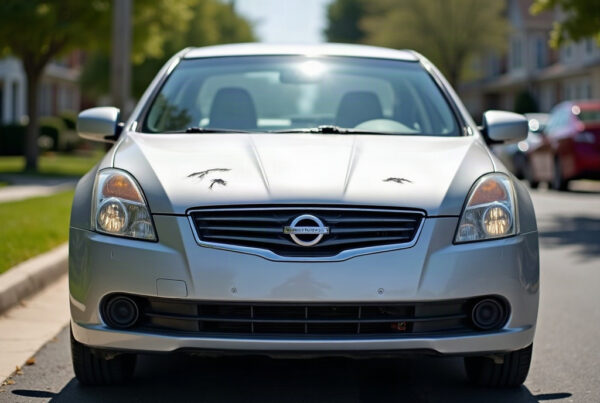
Impact chips have clean, sharp crater edges with exposed metal at the center. They're usually round or oval and penetrate straight down through the clear coat into the base coat or primer. These are caused by gravel, rocks, or parking lot door dings.
Delamination or flaking shows as sheets of paint lifting from a central point, with primer visible on the underside of the lifted coating. The edges are often irregular and curled. This is caused by adhesion failure – usually from salt penetration, UV degradation, or poor original application.
Oxidation or fading appears as a dull, chalky discoloration across a wider area, not a localized chip. This is UV damage weakening the clear coat's hardness over time.
Rust bloom is orange or brown discoloration around or beneath a chip. This means bare metal has been exposed long enough for corrosion to start – typically 30–90 days in New Castle's salt environment.
The distinction matters: a small impact chip might be cosmetic, but if it's exposed bare metal in winter, rust will follow fast. Delamination signals a deeper adhesion problem and often spreads. Oxidation suggests the clear coat is losing protection across the whole panel.
Key Takeaway: Impact chips are cosmetic until rust starts; delamination spreads; oxidation weakens the entire panel. Each requires a different response.
If you'd rather not start your search from scratch, Window Tint Installation Services serves New Castle, Bear and Newark and handles work like this regularly — happy to answer your questions and walk you through the options on the first call.
✓ Recommended locally: Window Tint Installation Services
Serving New Castle, Bear and Newark. Call (302) 832-2868 or get in touch »
What Are Your Best Options to Stop Paint Chips in New Castle?
Once you understand the cause, the solution becomes clear. Here are your three main options, ranked by effectiveness for chip prevention:
Paint Protection Film (PPF / Clear Bra) is the gold standard for stopping chips before they start. PPF is a polyurethane film 6–8 mils thick – three to four times thicker than factory clear coat. It's applied to high-impact areas (hood, bumper, fenders, mirrors) or the entire front end. The film absorbs the kinetic energy of gravel impact and self-heals minor scratches under low heat. If a rock does penetrate the film, the damage stops there; your paint underneath stays intact.
PPF won't prevent every chip – a severe impact can still mark the film – but it dramatically reduces the risk and cost of repair. Professional PPF installation in New Castle typically runs $400–$800 for a partial hood/bumper package, $800–$1,500 for full-front coverage, or $2,000–$4,000+ for a complete vehicle wrap.
Ceramic coating adds hardness (9H pencil hardness) and hydrophobic protection, making your paint easier to clean and more resistant to chemical etching from road salt. However, ceramic coating cannot absorb the kinetic energy of stone impacts. It's excellent for preventing UV oxidation and light marring, but it won't stop deep chips from gravel. Think of it as armor for the clear coat, not a barrier against impact.
DIY touch-up paint is the budget option – $10–$30 for a kit. It works for very small cosmetic chips that haven't exposed bare metal. For anything larger or already showing rust, professional touch-up ($50–$150 per chip area) or PPF is more cost-effective long-term.
The ROI math is simple: A partial PPF hood wrap costs $600. A professional panel repaint (if rust sets in) costs $1,500–$3,500. Ceramic coating costs $300–$1,500 but won't prevent chips. For daily drivers on New Castle roads, PPF on the front end is the best investment.
How Much Does Paint Chip Repair or Protection Cost in New Castle, DE?
Here's a transparent breakdown of what you'll spend, depending on your approach:
| Option | Cost Range | Best For |
|---|---|---|
| DIY touch-up kit | $10–$30 | Tiny cosmetic chips, no rust |
| Professional touch-up (per chip) | $50–$150 | Small chips, no bare metal exposure |
| Professional touch-up (5–15 chips) | $150–$400 | Cluster of small chips |
| Partial PPF (hood + bumper) | $400–$800 | High-impact areas only |
| Full-front PPF | $800–$1,500 | Hood, bumper, fenders, mirrors |
| Full-vehicle PPF | $2,000–$4,000+ | Complete protection |
| Ceramic coating | $300–$1,500 | UV and chemical protection (not chip prevention) |
| Single panel repaint (if rust develops) | $1,500–$3,500 | Damage control after neglect |
The urgency factor: An untreated chip exposing bare metal in New Castle's salt environment will develop rust within 30–90 days. Once rust starts, a simple touch-up won't work – you need panel refinishing or replacement, which costs 5–10 times more.
The prevention ROI: Spending $600 on a partial PPF hood wrap now prevents a $1,500–$3,500 panel repaint later. For a daily driver on I-95, that's a no-brainer.
Prices vary by installer and vehicle size, but these ranges reflect the New Castle County market. Local shops may vary ±20% depending on labor rates and material sourcing.
Recommended Auto Window Tinting in New Castle: Window Tint Installation Services
Ready to talk to a real local option? Window Tint Installation Services works with customers across New Castle, Bear and Newark from first question to finished job, with pricing and next steps laid out up front.
Window Tint Installation Services
Serving New Castle, Bear and Newark
FAQ: Car Paint Chipping in New Castle
Does road salt in Delaware actually cause paint to chip?
Direct Answer: Yes. Road salt doesn't directly cause impact chips, but it accelerates corrosion of exposed metal and weakens paint adhesion, turning a minor chip into a rust problem within weeks.
DelDOT applies brine and rock salt from October through March on I-95, Route 40, and Route 7 – roads throughout New Castle County. Learn more about Car Window Tinting Quote New Castle DE (2026). Sodium chloride penetrates micro-cracks in clear coat and reacts with bare metal underneath, initiating corrosion. In salt-laden environments, steel corrosion rates are 100–200 times faster than in dry conditions. A chip that might take months to rust inland will show rust bloom in 30–90 days here in New Castle.
How do I know if my paint chips will lead to rust?
Direct Answer: If the chip exposes bare metal (you can see silver or gray underneath the paint), rust will follow within 30–90 days in New Castle's salt environment.
Look at the chip closely. If it's a clean crater with exposed metal at the center, or if you can see primer (gray or white) underneath, bare metal is exposed. If the chip is only in the clear coat or base coat (you see color but no metal), you have more time. Either way, don't wait – touch it up or apply PPF before winter salt season (October–March) accelerates corrosion.
Is paint protection film worth the cost for a daily driver in New Castle?
Direct Answer: Yes, if you drive I-95 or Route 1 regularly. The cost of PPF ($400–$1,500 for partial coverage) is far less than a panel repaint ($1,500–$3,500) or the cumulative cost of repeated touch-ups.
For a daily commuter in New Castle County, highway gravel and winter salt are unavoidable. PPF on the hood and bumper – the highest-impact areas – pays for itself the first time it prevents a chip that would otherwise require professional repair. If your car stays parked in a garage, the ROI is lower. If you're on I-95 three days a week, PPF is essential.
What is the difference between ceramic coating and PPF for stopping chips?
Direct Answer: Ceramic coating adds hardness and water beading but cannot prevent deep impact chips. PPF absorbs kinetic energy and physically blocks gravel from reaching your paint.
Ceramic coating (9H hardness) is excellent for UV protection and chemical resistance – it prevents oxidation and makes your paint easier to clean. But it's only 1–2 mils thick and rigid; it can't absorb the energy of a rock at highway speed. PPF is 6–8 mils thick and flexible; it deforms on impact and self-heals minor scratches. For chip prevention on New Castle roads, PPF is the only solution. Ceramic coating is a complement, not a replacement.
How soon should I repair paint chips before rust starts?
Direct Answer: Within 30 days if the chip exposes bare metal. In New Castle's salt environment, rust can begin within weeks.
If you see exposed metal (silver or gray), don't wait for winter. Touch it up or apply PPF immediately. If the chip is only cosmetic (no bare metal), you have more time, but winter salt season (October–March) accelerates corrosion. The longer you wait, the more likely salt will penetrate the exposed area and start rust underneath the paint, making repair more expensive.
Can I fix small paint chips myself or do I need a professional?
Direct Answer: DIY touch-up works for very small cosmetic chips with no bare metal exposure. Anything larger or showing rust needs professional repair or PPF.
A DIY touch-up kit ($10–$30) can fill a tiny chip and blend the color reasonably well. But if the chip is large, irregular, or has exposed bare metal, DIY paint won't seal it properly – salt will still penetrate underneath. Professional touch-up ($50–$150 per chip) includes proper surface prep, primer, and clear coat, so it lasts longer. For multiple chips or high-impact areas, PPF is more cost-effective than repeated touch-ups.
How much does it cost to protect a car from paint chips in New Castle, DE?
Direct Answer: Partial PPF (hood and bumper) runs $400–$800; full-front coverage is $800–$1,500; full-vehicle PPF is $2,000–$4,000+. Ceramic coating (UV protection, not chip prevention) costs $300–$1,500.
The cost depends on coverage area and your vehicle's size. A partial hood wrap is the most popular option for daily drivers on New Castle roads – it protects the highest-impact areas without breaking the budget. If you want comprehensive protection, full-front PPF is worth the investment. Prices vary by installer; local shops in New Castle County typically align with Mid-Atlantic market rates.
Protecting Your Paint in New Castle: A Local Recommendation
Here in New Castle, we see the same paint damage patterns year after year: gravel chips from I-95, salt-induced rust, and freeze-thaw delamination. The vehicles that hold their value and stay looking sharp are the ones with proactive protection.
If you're ready to stop the cycle of chips and touch-ups, professional paint protection film installation is the most effective solution. Window Tint Installation Services offers PPF installation tailored to New Castle drivers – whether you need a partial hood wrap to cover high-impact areas or full-front protection for your daily commute on I-95.
Their team understands the local conditions: the salt exposure, the highway debris, and the freeze-thaw stress that makes paint protection essential here. They'll assess your vehicle, recommend the right coverage for your driving habits, and apply the film with precision so it blends seamlessly with your paint.
Why choose professional PPF over DIY or ceramic coating alone?
- PPF physically blocks gravel and salt from reaching your paint
- Self-healing properties mean minor scratches disappear under heat
- Transparent film preserves your car's original color and finish
- Protects resale value by preventing rust and permanent damage
- One-time investment prevents thousands in future repairs
Whether you're protecting a new vehicle before winter or salvaging a car already showing chips, professional installation makes a measurable difference.
Next Steps: Get Your Paint Protected
Paint chips are inevitable on New Castle roads – but rust and expensive repairs don't have to be.
Call our New Castle team at 302-832-2868 or visit windowtintdelaware.com to schedule a free paint protection consultation. We'll assess your vehicle, show you coverage options, and give you a transparent quote.
If you're in Bear, Newark, Middletown, or anywhere in New Castle County, we serve your area. Don't wait until winter salt season or the next highway trip. Protect your paint now, and keep your car looking sharp for years to come.